


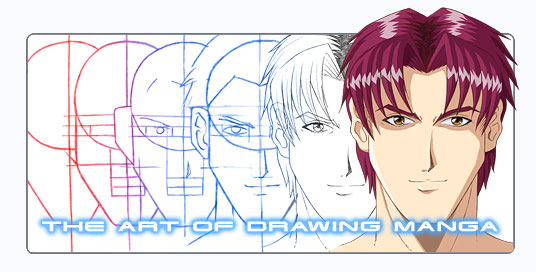
 How about creating a manga tutorial book?..
During the early months of 2003 I was contacted by the publisher '"Arcturus" about possibly working on a "how to draw manga" title on behalf of American book giants "Barnes & Noble". Drawing and writing a 144 page book seemed like a big task, especially considering the projject's tight deadline. I didn't want to pass up the opportunity, so I agreed to illustrate the book and began planning its content. I came up with a page by page break down of the book and roughly drew out many of the page ideas onto paper to get a feel for how it might look as a whole. It was to be a general manga style techniques book, looking at some of the typical themes an aspiring manga artist might want to learn about such as: faces, bodies, hair styles, characters in action etc. The books editor and I discussed and agreed what was needed, and I was allowed free reign mostly.
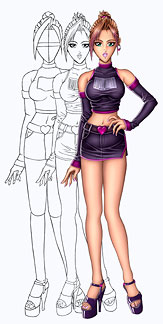 What was required?..
- Basically, enough content to fill 144 pages! This was delivered in the form of step-by-step drawings, a selection of eyes, hands, hair examples etc, finished coloured artworks, as well as drawing annotations and section descriptions. All artwork needed to be in a high resolution digital format ready for print. I did research into existing manga technique books on the market at the time, most popular being the Japanese "How to draw Manga" series. One thing these lacked was step-by-step processes and instructions. I wanted TAODM to show how to draw, rather than just presenting more or less finished works. The fact it was to be a full colour book was also a definite plus.
Managing the project...
It was clear at the start that this would be a tough project with such tight deadlines. It was important to plan out what was needed for each section and to work out a time schedule. I realised early on that it would be impossible to complete the project alone. I asked a couple of online artists I knew [Kim Loh and Dan Fielding] if they'd be interested in having some of their work published in the book in exchage for exposure and aknowledgement at the begining of the book- they agreed, as did my brother [James Krefta] who helpped with writing and scaning. The book's editor [Matt Smith] also helped with written content for the pages. It became a mini project management role so it was essential I kept up to date with everyone else's contributions and that I delegated work appropriately.
The results...
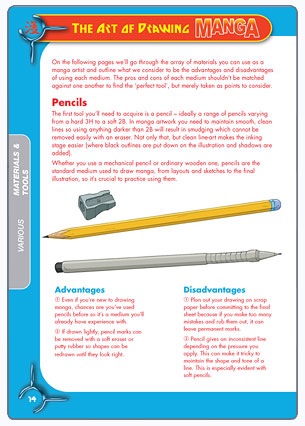
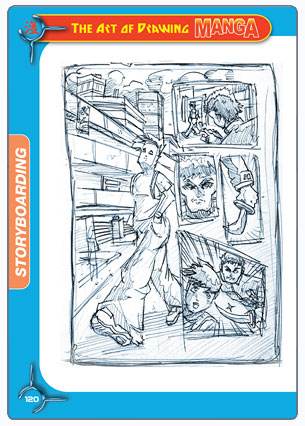
After supplying the material, it was the book designer's job to lay it out on the page. Some of these pages are shown below:
 |
 |
Materials |
Clothing examples |
The good thing about the Materials section is that it doesn't tell you what media to use, but explains why you might use a certain tool, allowing the reader to experiment or use what they feel comfortable with. Sometimes explaining a technique will only get people so far. The clothing page shows examples to illustrate how a three dimensional piece of material can be drawn in a two dimensional/ manga style form.
 |
 |
Comic page sketch |
Characters in action |
The comic/ story board pages show progression from initial sketches (not all artwork starts in a glossy coloured format). Dan's ninja girl on the right shows potential manga artists that practice makes perfect! Having other manga artist's work featured in the book helped to show that manga isn't just one generic style of drawing.
 Conclusion...
As these sorts of books go, it's a pretty good product! It's cool for me to see my work in print and to hear positive feedback from people who bought the book, had a go and have improved their drawing skills.
It's sold over 150,000 copies around the world including USA, Canada, Australia and Europe, and has been translated into German, under the names "Manga Zeichnen für Freaks" and "Manga zeichnen für Einsteiger", Spanish under the name "El arte de dibujar manga" and Polish under the name "Manga Sztuka Rysowania ". On top of this, Barnes & Noble released a Drawing Kit version, which included a smaller 80 page edit version of the book called 'Drawing Manga in Simple Steps' plus art materials- pencils, paints, ink etc.
The book has had a good run and came out just at the start of the 'manga tutorial book boom'. Several years on and I would love the chance to produce a totally updated, revised edition. I never expected it to become so popular, so with more time and now that my art skills and technical knowledge have increased I'm sure I could create a far superior product! Perhaps I will be given this opportunity in the future?

